
Sivrice Huyuk Protestosu
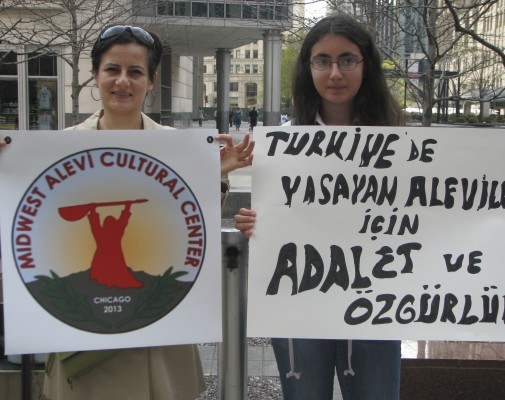
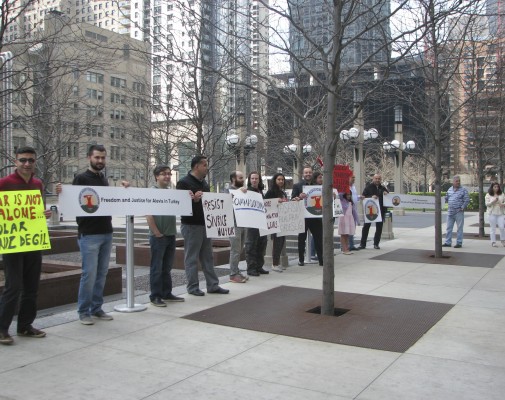

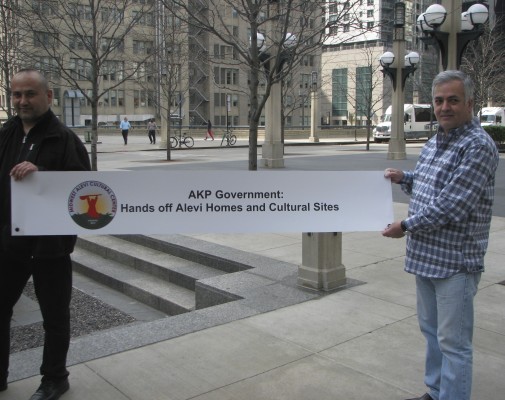
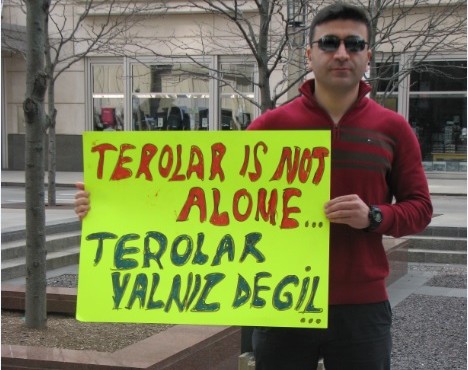
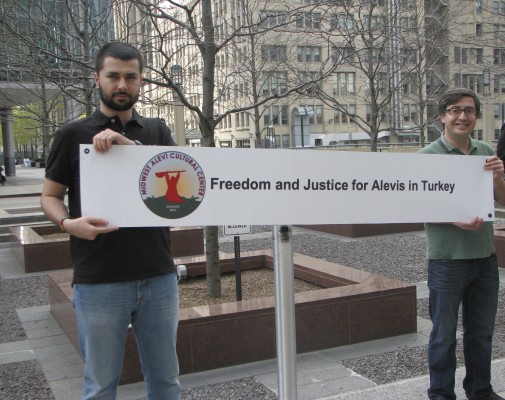
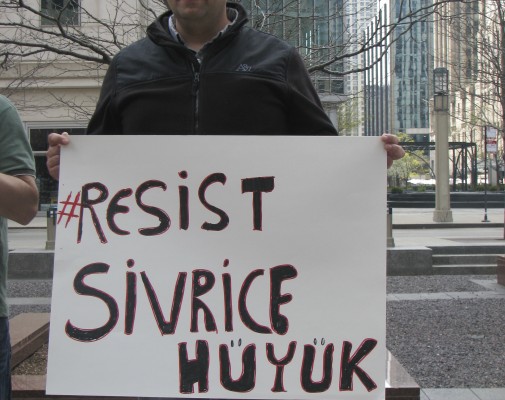
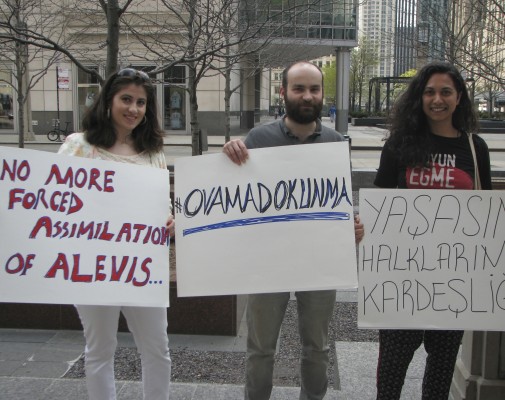

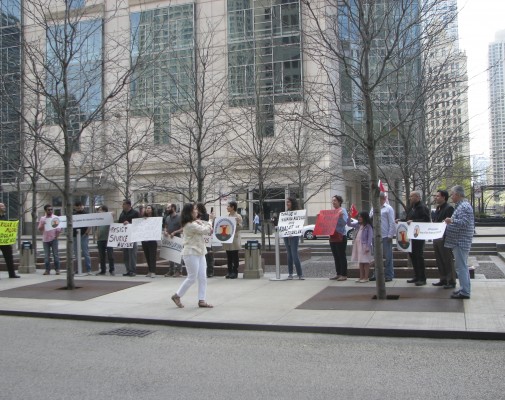
Orta-Batı Amerika’da yaşayan Alevi-Bektaşi Toplumunun üyeleri olarak, Türkiye’de AKP hükümeti tarafından Süriye’li mültecilerin dramının Anadolu’da yaşayan Alevilere karşı bir demografik savaş aracı olarak kullanılmasını Şikago Konsolosluğu onünde protesto ettik.
Bunun o bolgelerde yaşayan Alevi-Bektaşilerin asimilasyonu için uygulamaya sokulan demografik ve kültürel bir transformasyon projesi olduğuna inaniyoruz.
MACC Kuzey Amerika’da mevcut diğer Alevi-Bektaşi kuruluşlariyla birlikte, AKP hükümetinin ayrılıkçı uygulamalarina karşı durmaya devam edecektir.
Sivrice Huyuk Is Not Alone
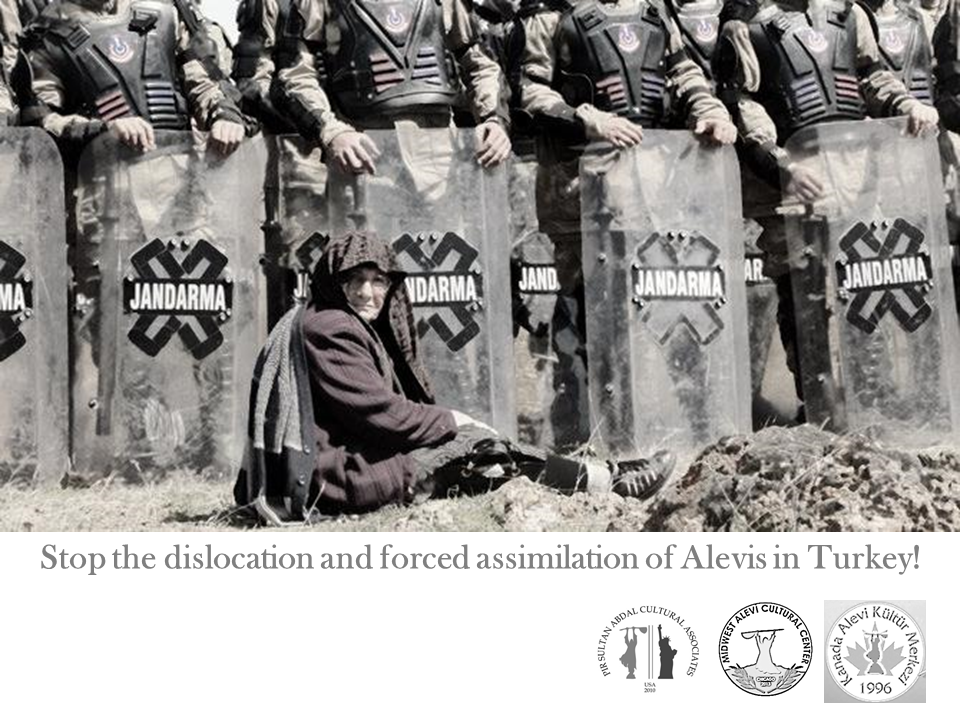
PUBLIC DECLARATION TO CONDEMN AKP GOVERNMENT’S USE OF
SYRIAN REFUGEES’ PLIGHT AS A WEAPON OF DEMOGRAPHIC
WARFARE AGAINST THE ALEVIS IN TURKEY
We, as members of the organizations and groups listed below, living in different parts of
North America, are making this public declaration to express our deep concern about the
recent plans of the AKP government to establish container cities for Syrian refugees in a
handful of remaining Alevi enclaves in Anatolia which, we believe, is a deliberate and
cunning project aimed at surreptitiously implementing a demographic and cultural
transformation of related regions that will dislocate Alevis from their historical homes
and ancient sacred sites.
The reprehensible use of the Syrian refugees as instruments to advance the AKP
government’s anti-Alevi sectarian agenda came to surface recently with the start of the
construction of a container city for around 27,000 Sunni Syrian refugees in the middle of
sixteen predominantly Alevi populated villages with a combined population of 4,000 in
the Pazarcık district of Turkey’s southern province of Maraş. The project was launched
late in March 2016 without any prior public notice or discussion, and is continuing under
heavy gendarmerie protection, despite mass demonstrations and an ongoing peaceful sitin
protest by the local residents. The protestors have been attacked more than once by the
gendarmerie with tear gas and water cannons resulting in the death of 82 year old Mor
Ali Kabayel, who died due to complications caused by the tear gas. The local residents
not only object to the unlawful confiscation of their animals’ grazing land, but are also
deeply concerned about their security. They fear that Syrian jihadists, infamous for their
extreme religious hatred and mass-murders of such minorities as the Alevis, may move
into their midst disguised as refugees. Such fears are also historically well-grounded, as
Maraş is one of several areas where Alevis were subjected to mass killings by ultra-right
wing Sunni radicals in the late 1970s, in the run up to the 1980 military coup d’état. In
the wake of the massacres, many Alevis fled their homes in Maraş to migrate to urban
centers within Turkey and in different Western countries, leaving behind a severely
reduced Alevi population. The local residents believe that the settlement of
disproportionately high numbers of Syrian refugees will not only dwarf them numerically
in their own homes, but also lay the ground for future sectarian conflicts and new waves
of Alevi emigration, or even massacres, thereby striking a final blow to Alevi presence in
the environs of Maraş.
What lends credence to these suspicions, and adds to the gravity of the situation, is the
accumulating evidence that the container city in Pazarcık-Maraş may be just the tip of the
iceberg of a much broader and systematic demographic warfare launched by the AKP
government with the ultimate aim of eradicating all the remaining Alevi enclaves from
rural Anatolia. While the mainstream Turkish media, working under heavy government
censorship, is virtually silent about the issue, information shared through social media has
exposed several other planned camps in other regions such as the districts of Divriği,
İmranlı, Zara, and Yıldızeli in Sivas, as well as Akçadağ in Malatya, all of which have
only one thing in common: they are all areas well-known for their almost exclusively
Alevi populations, and for housing several ancient sites considered sacred by the Alevis.
Indeed, anybody with a basic familiarity of the demographic map of Anatolia looking at
the list of the planned container cities for Syrian refugees would readily get the
impression that they were handpicked almost exclusively with that criterion in mind.
Also telling, the government has so far failed to respond to two official inquiries from the
two opposition parties of the parliament requesting a complete list of the locations of all
planned container cities for the Syrian refugees, and an explanation of the basis on which
they were chosen.
The AKP government’s apparent instrumentalization of the Syrian refugees’ plight as a
weapon of demographic warfare against the Alevis is not without a broader context of
repressive and assimilationist state policies targeting this historically disenfranchised
religious minority. Though surprisingly little known outside of the country, Alevi
communities, together with the kindred Bektashi order, constitute the second largest
socio-religious community in Turkey, making up around 15% of the country’s overall
population. The Alevis are clearly set apart from mainstream Muslims by their markedly
esoteric teachings, which bear a close affinity with Sufism and a number of pre-Islamic
mystical traditions. They are further differentiated from Sunni or Shi‘i Muslims by their
non-observance of formal obligations of normative Islam and their distinct liturgy, the
cem, which both men and women attend, contrary to the strict rules of gender segregation
prescribed in sharia. Though Alevi mystical poetry and music, traditionally performed
during cem rituals, remain important components of the Alevi collective identity, most
Alevis today live secular lives, and are associated with secular progressive politics and
ideas.
In the past, Alevis practiced their religion in secret due to fears of harassment by their
Sunni neighbors and the state authorities who viewed them with suspicion because of
their religious and political non-conformism. Despite the officially secular character of
the Turkish Republic, and Alevis’ civic struggle for legal recognition and equal rights
since the Alevi cultural revival of the early 1990s, Alevis are still deprived of their basic
religious freedoms, and routinely face formal and informal discrimination. Their places
of worship, the cemevis, are not legally recognized and Alevi children are indoctrinated
with the Sunni-orthodox version of Islam in the mandatory religious classes that all
students in Turkey must attend from elementary school through high-school— on both
accounts, the AKP government stands in clear violation of the principle of secularism
enshrined in the Turkish Constitution, as well as of the legally binding decisions of the
European Court of Human Rights that, in its various verdicts, called on Turkey to end
compulsory religion classes, and treat the cemevis on a par with other houses of worship
such as mosques, churches, and synagogues.
In the last five years of AKP rule, Alevis’ disenfranchisement has deepened even further
with the government’s accelerated top-down Islamization of broader Turkish society and
the corollary intensification of sectarian discourse in its domestic and foreign policy. The
handpicking of Alevi villages as sites to build container cities for Sunni Syrian refugees
is yet another example of the aggressive and extremely disconcerting social-engineering
project implemented by the AKP government to recast Turkish society in accordance
with a conservative form of Sunni Islam; it, in fact, represents an attempt by AKP to
carry its assimilationist policies to a whole new level of viciousness.
We, the undersigned, find unacceptable, and condemn, the AKP government’s concerted
efforts to eliminate Alevi demographic presence in Anatolia, whether by dislocating them
from their homes or by assimilating them through state-led Islamization. We, therefore,
call on the AKP government to cease immediately the construction of a container city for
Syrian refugees in Pazarcık-Maraş, rescind all others planned in a handful of Alevi
enclaves in rural Anatolia, and to abandon all of its sectarian and assimilationist policies
targeting the Alevis. We also call upon the members of the press and the members of
NGOs committed to the promotion of democracy and human rights in the US, in Turkey,
and in the rest of the world to be more sensitive and diligent about addressing problems
faced by the Alevi community in Turkey, and to put due pressure on the AKP
government to end its discriminatory policies and practices, and to respect Alevis’
religious and cultural freedoms.
PIR SULTAN ABDAL CULTURAL ASSOCIATES USA – AMERİKA PİR
SULTAN ABDAL KÜLTÜR DERNEĞİ, New York, 2010
PIR SULTAN ABDAL CULTURAL ASSOCIATES USA
MIDWEST ALEVI CULTURAL CENTER – ORTA BATI AMERİKA ALEVİ
KÜLTÜR MERKEZİ, Chicago, 2013
MIDWEST ALEVI CULTURAL CENTER
CANADIAN ALEVI CULTURE CENTER – KANADA ALEVİ KÜLTÜR
MERKEZİ, Toronto, 1996
CANADIAN ALEVI CULTURE CENTER
PIR SULTAN ABDAL CULTURAL ASSOCIATES IN WASHINGTON, D.C. –
PİR SULTAN ABDAL KÜLTÜR DERNEĞİ WASHINGTON, D.C. ŞUBESİ, 2015
PİR SULTAN ABDAL KÜLTÜR DERNEĞİ WASHINGTON
Berkin Elvan Bursu
Değerli dostlar,
Amerika Pir Sultan Abdal Kültür Derneği tarafından başlatılan ve Berkin Elvan kardeşimiz adına düzenlenen Berkin Elvan Bursu’nu duyurmak istiyoruz.
Gezi Parkı direnişinde 14 yaşında başından vurulan ve günlerce komada kalan, 15 yaşında yitirdiğimiz güzel kardeşimiz Berkin Elvan milyonlarca insana umut olmuştu. Onun adına düzenlenen bu bursa katkı sağlayarak sizlerde bizlerden destek bekleyen güzel genç kardeşlerimize destek olabilirsiniz.
Yaptığınız bağışlar 501c(3) statüsünde olacağı için vergiden düşülebilir. Detaylı bilgiler ektedir.
Saygılarımızla.

Batikent Serçeşme Cemevi ve Kültür Merkezi Açılışı
Hünkâr Hacı Bektaşi Veli Vakfı tarafindan 7 Kasim 2013’de Ankara, Batikent’te Serçeşme Cemevi ve Kültür Merkezi’i hizmete açıliyor.
Haci Bektasi Veli Dergahi Postnişi Veliyettin Hürrem Ulusoy “Dergâh’ta Birlik” çabalarının uzun sürdüğünü, Serçeşme Cemevi’nin bu birlikteliğin güzel bir ürünü olduğunu ifade etti.
Ankara’da bir araya gelecek olan canlari selamliyoruz.
Amerika’da da benzeri bir beraberliği sağlayabilmek için Midwest Alevi Cultural Center olarak bu yola gönülden bağlı olan canları bir araya getirmek için calışmalarımızı sürdüreceğiz.